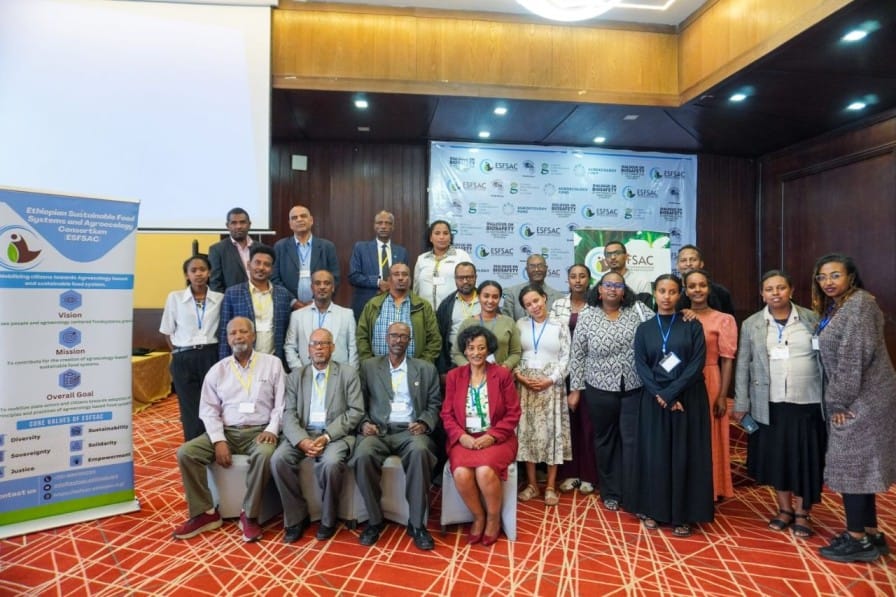
The Ethiopian Sustainable Food Systems and Agroecology Consortium (ESFSAC), in partnership with PELUM Ethiopia and with financial support from the Global Greengrants Fund and the Agroecology Fund, convened a multi-stakeholder Dialogue on Biosafety and Modern Biotechnology: Balancing Innovation, Biodiversity and Food Sovereignty on 28 September 2026 at Azzeman Hotel, Addis Ababa.
The dialogue brought together stakeholders from government institutions, research and academia, civil society, biodiversity and seed-system organizations, and other relevant sectors to foster an open and evidence-based conversation on the role of modern biotechnology in Ethiopia’s agriculture and food systems.
Creating Space for Informed Dialogue
Modern biotechnology is increasingly influencing agriculture, food production and natural resource management globally. Its applications offer potential opportunities to address challenges such as crop pests and diseases, climate-related stresses, productivity constraints and nutritional needs. At the same time, these developments raise important questions around biosafety, biodiversity, human and environmental health, farmers’ rights, seed systems and food sovereignty.
For Ethiopia, these discussions are particularly significant given the country’s rich agricultural and ecological diversity, farmer-managed seed systems and diverse genetic resources. Millions of smallholder farmers continue to rely on locally adapted crop varieties, farmer-to-farmer seed exchange and community-based seed systems.
Recognizing the importance of bringing different perspectives to the table, the dialogue created a platform for stakeholders to examine both the opportunities and emerging concerns associated with modern biotechnology and its governance in Ethiopia.
Exploring Biotechnology, Biosafety and Food Systems
The dialogue featured discussions on a range of interconnected issues, including:
- Modern biotechnology and genetic modification: the potential as science, opportunities and challenges for Ethiopia’s agriculture;
- Biosafety Governance: Ethiopia’s policies, international commitments and emerging considerations;
- Biotechnology and Implications on food systems: on food safety, health, nutrition, environment, sustainable food system transformation;
- Lessons and experiences from genetically modified (BT) cotton production: evidences, lessons and regulatory perspectives;
- Enset: Innovation Rooted in Biodiversity for Food Sovereignty – sharing experience of Arbaminch university in linking technology and innovation for enset value addition.
The discussions also examined the implications of modern biotechnology for food systems focusing on for farmers’ seed systems (seed diversity, seed saving and exchange practices, seed access, affordability), farmers’ rights as well as seed and food sovereignty. Participants reflected on the safeguards, research on risk assessment, post-release monitoring and public-participation mechanisms needed to support transparent and accountable decision-making.
Connecting Innovation with Biodiversity and Food Sovereignty
A key focus of the dialogue was the relationship between innovation and Ethiopia’s broader food-system and biodiversity priorities. Participants explored how biosafety and biodiversity frameworks can work together, while considering the conservation of genetic resources, community seed banks, farmer knowledge and strengthened institutional coordination.
The dialogue emphasized the value of creating space for diverse perspectives, including scientific, regulatory, farmer/pastoral communities, consumers, and civil society perspectives—to engage constructively. Such spaces are important for identifying areas of convergence, clarifying concerns and knowledge gaps, and informing future action.
Towards Continued Multi-Stakeholder Engagement
The dialogue concluded with a moderated synthesis bringing together presenters and invited discussants to reflect on practical principles for navigating the opportunities and challenges associated with modern biotechnology while considering biodiversity, human health, farmers’ rights, seed diversity and food sovereignty.
As Ethiopia continues to strengthen its agricultural and food systems, sustained dialogue among government, research institutions, farmers, civil society, private-sector actors and other stakeholders will remain important. ESFSAC and its partners are committed to supporting inclusive spaces for knowledge exchange, evidence-based discussions and constructive engagement on issues shaping Ethiopia’s sustainable food systems.
The dialogue represents another step toward strengthening informed public conversation on how innovation, biodiversity and food sovereignty can be considered together in Ethiopia’s evolving food-system landscape.