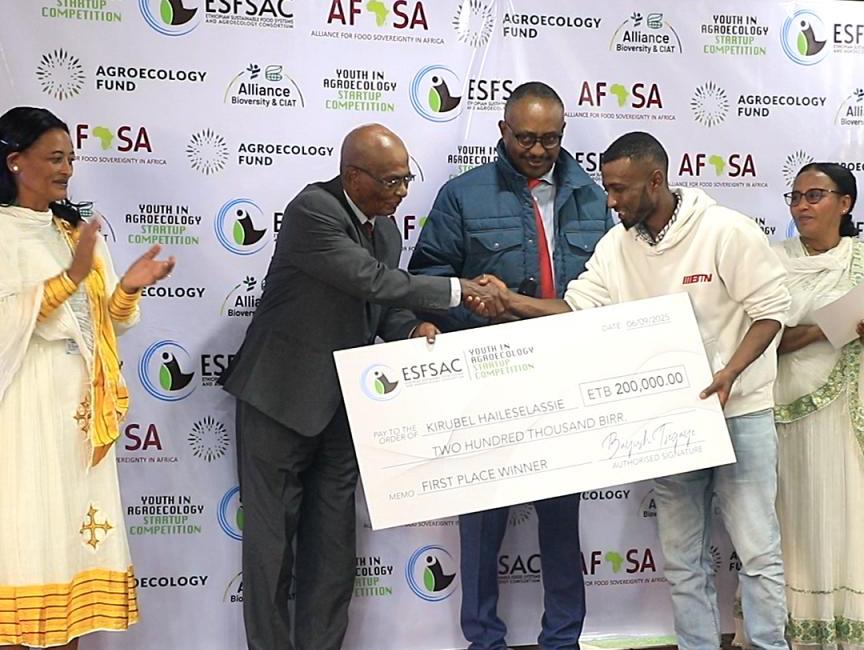
Meet Kirubel Haileselassie, the previous first place winner of the 2025 Youth in Agroecology Startup Competition. Please read this short interview.
ESFSAC: Kirbuel, please introduce yourself and tell our readers about your agroecology enterprise.
Kirubel: For those who may not know me, my name is Kirubel Haileselassie, and I’m the prize winner of the 2025 Youth in Agroecology Startup Competition. I competed representing Kirubel and Friends Farm Enterprise, a venture I co-founded with my friends.
ESFSAC: What agroecological principles and practices are at the heart of your business?
Kirubel: At the heart of everything we do is a simple belief: farming should work with nature, not against it. On our farm, we weave together growing vegetables, fruit trees, and beekeeping in a way that support one another – turning farm organic waste into rich soil, creating a thriving habitat for local bees. But we didn’t want to stop at our own farm gate. We’ve brought that same commitment to care, efficiency and sustainability into our aggregation work, partnering with local, urban and peri-urban growers to champion agroecologically produced food. By cutting down food miles, reducing post-harvest waste and keeping things local, we’re building a food hub that feeds our community while giving back to the earth.
ESFSAC: How has ESFSAC’s recognition, mentorship and network support contributed to your development as a youth agroecology entrepreneur (start-up)?
Kirubel: The support from ESFSAC has been a game-changer for us. It went far beyond the initial award. The recognition gave us immense credibility, which was crucial for a youth-led start-up trying to prove its model. This credibility opened doors that were previously closed. For instance, we were able to build collaborations with institutions that support the agriculture sector through low-interest loans.
The mentorship, networking opportunity not only brought visibility, but also built our confidence to boldly apply and succeed in other calls, helping us refine our strategy and pursue our vision.
ESFSAC: Take us back to the award winning moment — what did it mean to have your enterprise recognized through the ESFSAC Youth Competition 2025?
Kirubel: Winning the 2025 ESFSAC’s Youth Agroecology felt like an incredible validation of our startup and it affirmed our team to stand firmly to meet our vision. When they called our name, it wasn’t just a personal victory, it was a powerful confirmation that youth-led, sustainable agriculture matters and that our circular food hub model is heading in the right direction. That recognition brought a wave of momentum, giving us the institutional confidence to scale up our aggregation work, connect more local farmers to reliable markets, and prove that agroecology is the future of food.
ESFSAC: Every entrepreneurial journey has challenges. What has been your biggest obstacle, and how did you respond to it?
Kirubel: As many startups, our biggest obstacle was securing finance and managing cash flow to support our growth. To respond, we’ve taken a multi-pronged approach. We used the ESFSAC’s award money, investing in critical inputs and business formalization to build a stronger foundation. We have actively pursued collaborations that offer low-interest loans and applied to other entrepreneurship support programs. Furthermore, we’ve refined our business plan to be more financially robust, focusing on building reliable and prearranged supply linkages.
ESFSAC: Finally, what practical advice would you give to this year’s youth finalists who want to turn their agroecology ideas into successful and sustainable enterprises?
Kirubel: My advice is, believe in your vision and don’t be scared to formalize it. Getting our enterprise registered was a critical step that helped us build trust with partners and opened doors to secure funding. Second, be persistent and leverage every opportunity. Use competitions like this not just for the prize money, but for building your visibility, getting valuable feedbacks, and for networking. Apply to every relevant program, attend networking events and connect with every expert you can. Finally, be practical and plan for financial sustainability. A great agroecological idea must also be a good business.
Conclusion: Kirubel’s journey is a testament to strong commitment and devotion. His work challenges the status quo, transforming the business landscape, creating platforms that empower youth and women, and build spaces that encourages youth creativity and innovation.
Visit our new Database of Finalist Startups from the Youth Agroecology Startup Competition.
—-
This content is part of our Newsletter, August Edition. Find the full Newsletter in PDF.