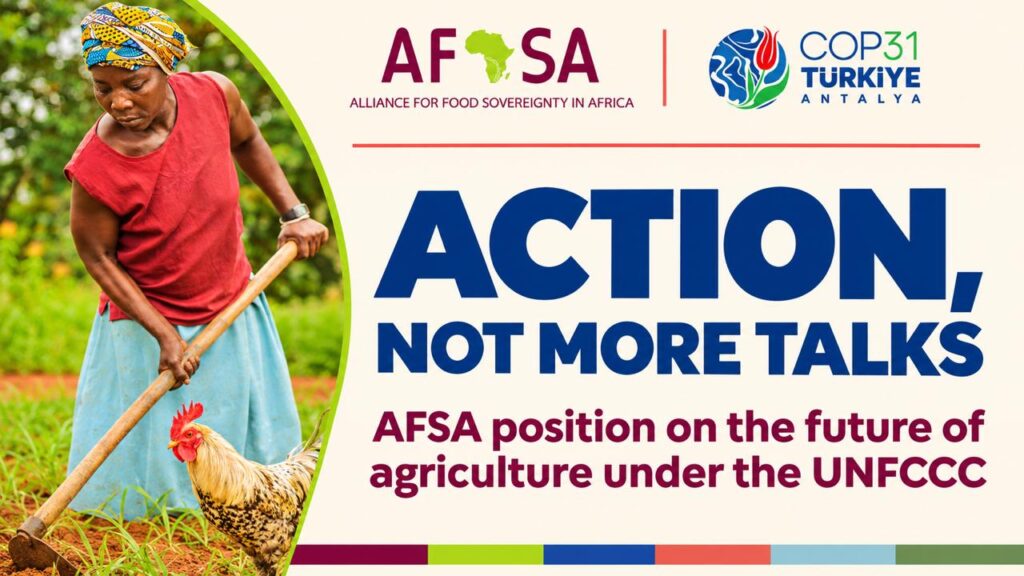
For nine years, global climate negotiators have discussed agriculture through the Koronivia Joint Work on Agriculture and the Sharm el-Sheikh Joint Work on Implementation of Climate Action on Agriculture and Food Security (SJWA), producing endless workshops and reports while delivering almost nothing to the people who feed Africa. Meanwhile, climate change has reduced African agricultural productivity growth by 34% since 1961 and affected at least 13 million people through disasters in 2025 alone. Despite bearing the brunt of the crisis, food systems receive only about 7% of global climate finance, and a mere 0.8% reaches small-scale agrifood systems.
As governments gather in Antalya, Türkiye, for COP31, the Alliance for Food Sovereignty in Africa (AFSA)—representing roughly 200 million small-scale food producers across 50 African countries—is demanding an immediate end to this implementation gap. As AFSA General Coordinator Dr. Million Belay notes, “We cannot keep calling meetings progress when farmers return home to the same problems without the resources to address them. COP31 must answer a simple question: where is the money, who will deliver it, and when will it reach the people who need it?”
In its newly launched official COP31 position paper, AFSA calls on Parties to replace open-ended dialogues with a time-bound, funded implementation framework featuring measurable annual targets and independent public reviews. Specifically, negotiators must commit new, predictable, grant-based climate finance with simplified direct access for small-scale producers, explicitly recognize and fund community-led agroecology within national climate plans (NDCs and NAPs), and transform the Sharm el-Sheikh online portal into a publicly tracked mechanism connecting producer priorities with funding.
At COP31, world leaders face a defining choice: trap agriculture in another cycle of empty promises, or hold developed nations accountable to their finance obligations while guaranteeing farmers, Indigenous Peoples, women, and youth real decision-making power. Africa’s food producers have waited nine years—they cannot afford to wait another four. Read the full announcement on the AFSA website or download the complete COP31 position paper (PDF) to explore the demands in detail.