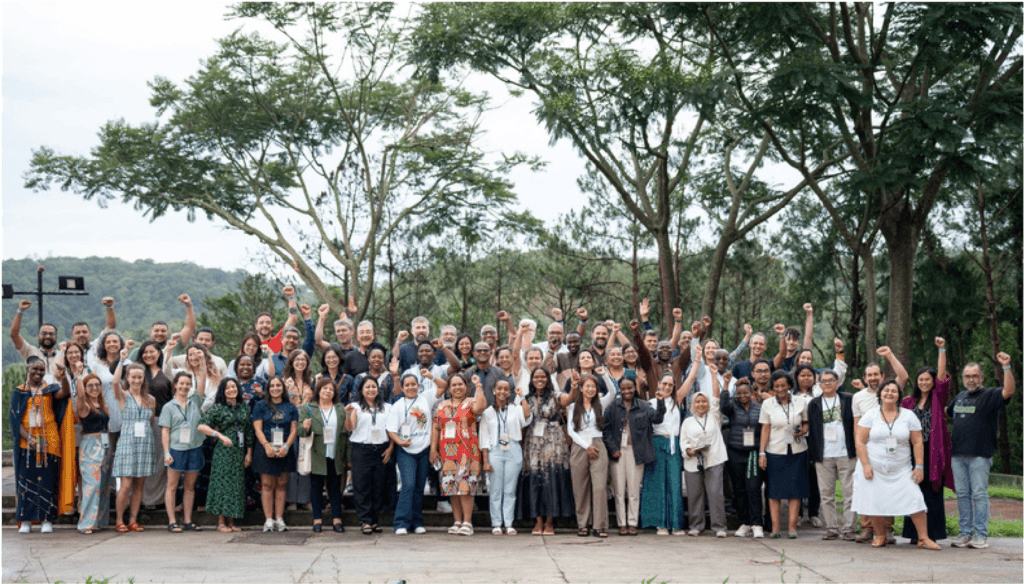
The first IPA global convening in Guararema, Brazil successfully brought together a diverse coalition of over 90 participants representing 41 collaboratives across 11 countries and the EU. This gathering was dedicated to advancing Participatory Action Research (PAR) as a critical methodology for strengthening climate and agroecology policy advocacy. The event opened with powerful reflections on Brazil’s historical journey and their most influential social movements advocating for agrarian reform and an equitable food economy grounded in family farming. This set the stage for a rich exchange of strategies on building equitable food systems encompassing community-led solutions.
Throughout the convening, deep discussions centered on the transformative potential and practical challenges of PAR. Participants critically examined how to move beyond extractive research models to co-create knowledge genuinely with farmers and indigenous communities, affirming their agency and ownership of data. This theoretical framework was powerfully brought to life during a field visit to the Florestan Fernandes National School and an MST family settlement. These visits offered a grounded perspective on how social movements, agroecology and community-led action can shape more just and sustainable food systems.
The IPA global convening also hosted a vibrant communications exhibition, sharing agroecology products, grains, honey, herbs, along with cultural items representing the knowledge and traditions of indigenous communities. Partners also reflected on ways to strengthen communication strategies for agroecology advocacy, reinforcing shared messages and amplifying movement led solutions.
Day 4 of this powerful gathering coincided with two significant dates, honoring the historical significance of Brazil’s Black Awareness Day and Mexican Revolution Day, uniting the global gathering in a shared commitment to justice and dignity.
Key insights exchanged
- United Nations Declaration on the Rights of Peasants and Other People Working in Rural Areas (UNDROP) and its relevance for grassroots movements.
- Women in agroecology and the urgency of securing land rights.
- Youth and agroecology, highlighting the importance of intergenerational transfer of knowledge.
- Strategies for influencing narratives to elevate agroecology as a climate and justice solution. The role of animals in agroecology—far beyond bio inputs, integral to healthy ecosystems. The importance of Participatory Guarantee Systems (PGS) in strengthening local markets and trust.
- International perspective of the social movement from the start.
- The culture of appreciating their heroes.
ESFSAC contributed valuable insights from the Ethiopian context. The meeting was a pivotal learning platform for forging partnerships and integrating into broader African and international agroecological advocacy networks, signaling a strengthened, unified movement poised to drive systemic change. The convening concluded with a firm resolve to strengthen global and cross-regional collaboration and amplify advocacy efforts.